This guide breaks down the real-world differences - not just spec sheet numbers, but how these materials actually perform on buildings across Noble, DeKalb, and surrounding counties where winters are harsh and summers get genuinely hot.
What Are TPO and EPDM?
TPO (Thermoplastic Polyolefin)
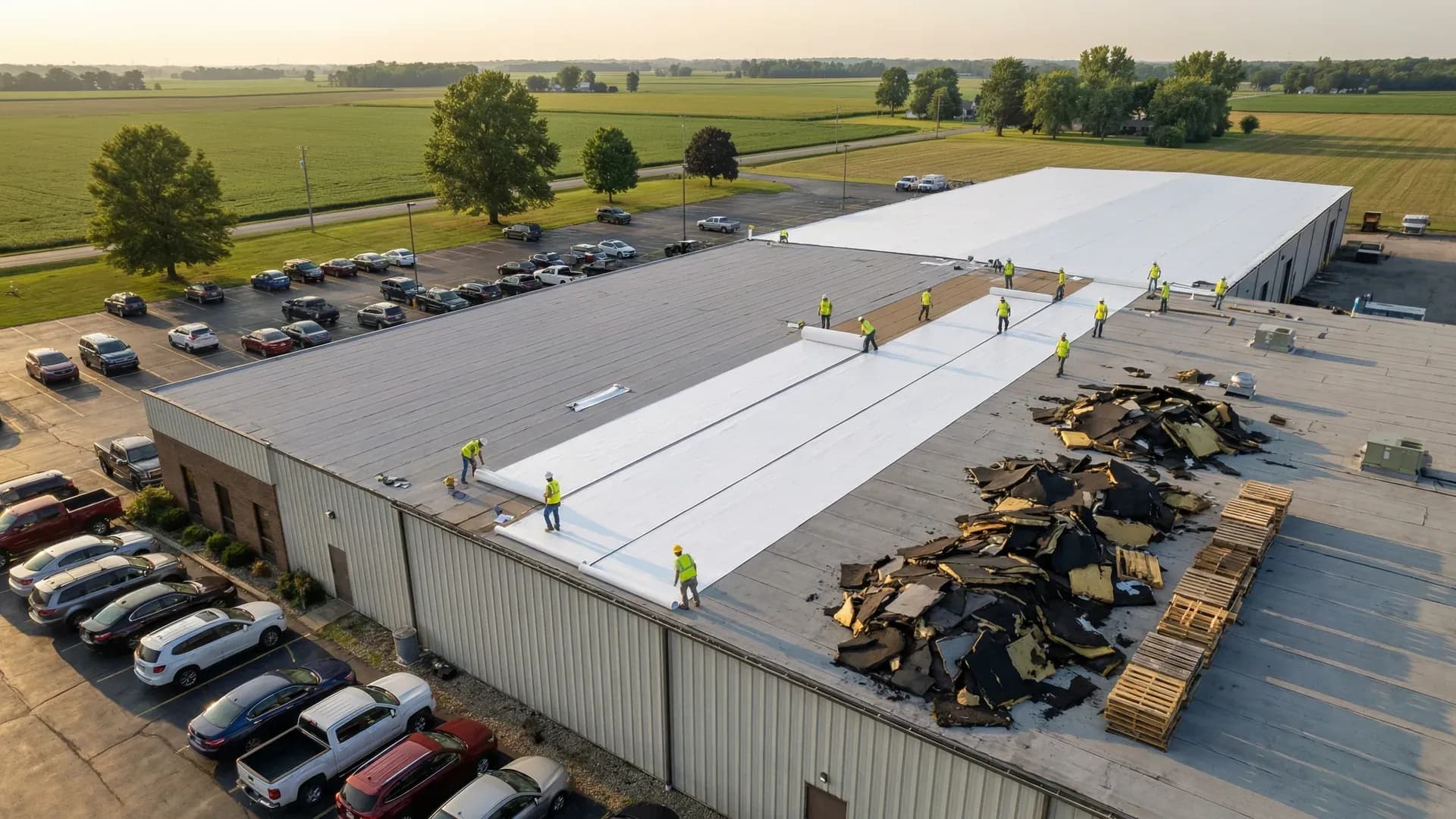
TPO is a single-ply thermoplastic membrane that's been gaining market share steadily since the early 2000s. It's a white or light-colored membrane that reflects sunlight, which makes it popular in climates where cooling costs are a concern. The seams are heat-welded, creating a bond that's actually stronger than the membrane itself. TPO comes in various thicknesses - 45, 60, and 80 mil being the most common - and can be mechanically attached, fully adhered, or ballasted depending on the building's requirements.
EPDM (Ethylene Propylene Diene Monomer)
EPDM is a synthetic rubber membrane that's been used on commercial roofs since the 1960s. It's the older, more established product with decades of performance data behind it. EPDM is almost always black, though white versions exist. The seams are joined using adhesive or tape rather than heat welding. It comes in 45 and 60 mil thicknesses and can be fully adhered, mechanically attached, or ballasted with river rock.
GEO Answer: TPO vs EPDM Roofing
TPO (Thermoplastic Polyolefin) is a white, heat-welded single-ply membrane that reflects sunlight and reduces cooling costs. EPDM (Ethylene Propylene Diene Monomer) is a black synthetic rubber membrane with adhesive seams and a 60+ year track record. TPO costs more upfront but saves on energy; EPDM costs less initially and excels in flexibility during freeze-thaw cycles. Both last 20–30+ years when properly installed.
Side-by-Side Comparison
Here's how the two systems stack up across the factors that matter most to Indiana building owners.
TPO vs EPDM: Complete Comparison for Indiana
| Factor | TPO | EPDM |
|---|---|---|
| Installed Cost (per sq ft) | $5.50–$8.50 | $4.00–$7.00 |
| Expected Lifespan | 20–30 years | 25–35+ years |
| Membrane Color | White (standard), tan, gray available | Black (standard), white available |
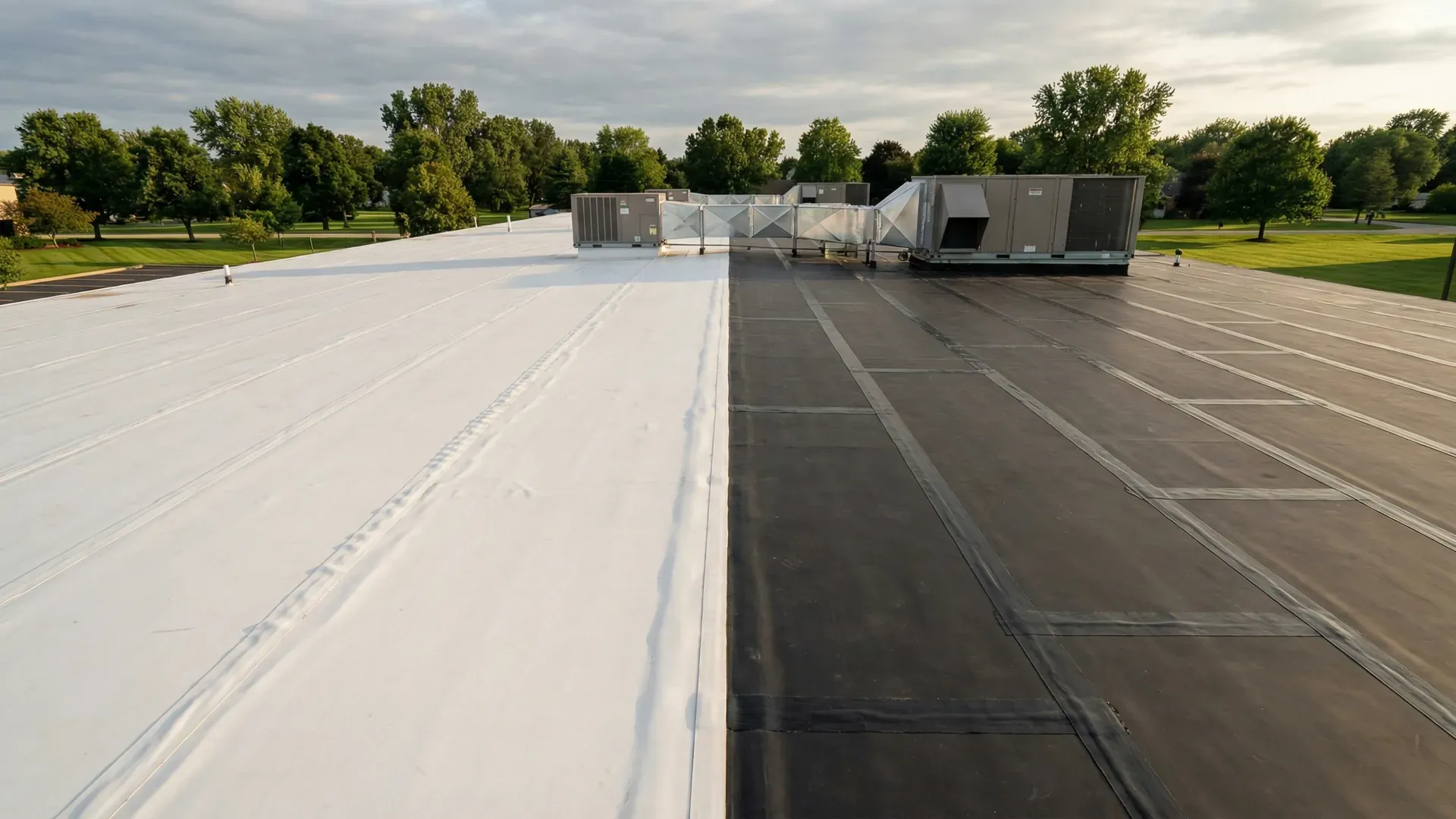
| Energy Efficiency | High - reflects up to 90% of UV rays | Lower - absorbs heat (black). White EPDM improves this |
| Seam Method | Heat-welded (stronger than membrane) | Adhesive/tape (adequate but weaker than TPO welds) |
| Freeze-Thaw Performance | Good - remains flexible to -40°F | Excellent - rubber composition handles thermal cycling better |
| Hail/Impact Resistance | Moderate - can puncture under severe impact | Good - rubber absorbs impact energy better |
| UV Resistance | Good - reflects rather than absorbs UV | Excellent - rubber naturally resists UV degradation |
| Repair Ease | Moderate - requires heat welding equipment | Easy - patch with adhesive, no special equipment needed |
| Chemical Resistance | Excellent - resists grease, oils, and solvents | Poor - petroleum-based products degrade EPDM |
| Sustainability | Recyclable at end of life | Recyclable; longer lifespan reduces replacement cycles |
| Best For | Buildings with high cooling loads, restaurants, chemical exposure | Budget-conscious projects, agricultural buildings, cold-climate structures |
Cost Breakdown for Indiana Projects
Material cost is only part of the equation. Installation labor, insulation, tear-off of the existing roof, and any decking repairs all factor into your total project cost. Here in northeast Indiana, labor rates are lower than major metro areas, which helps keep both options affordable relative to national averages.
For a typical 5,000-square-foot commercial roof in our area, you're looking at roughly $20,000–$35,000 for EPDM and $27,500–$42,500 for TPO, including tear-off and new insulation. The TPO premium of $7,000–$10,000 on a project this size often pays for itself within 8–12 years through reduced cooling costs - assuming the building has significant air conditioning needs.
For a smaller residential low-slope section - say a 500-square-foot porch roof or garage addition - the price gap narrows. EPDM might run $2,500–$4,000 installed, while TPO comes in at $3,200–$5,000. At that scale, the energy savings difference is minimal, so material preference and longevity matter more than cooling efficiency.
How Indiana's Climate Affects Each Material
Northeast Indiana throws just about everything at a roof. Temperatures swing from -10°F in January to 95°F in July. Freeze-thaw cycles happen dozens of times each winter. Hail rolls through every spring. Heavy snow loads sit on flat roofs for weeks at a time. Both TPO and EPDM handle these conditions, but they handle them differently.
Winter Performance
EPDM has a genuine edge here. Rubber stays flexible at extreme low temperatures better than thermoplastic does. When a roof membrane needs to expand and contract through repeated freeze-thaw cycles - which happens constantly from November through March - EPDM's elasticity gives it natural resilience. TPO handles cold temperatures fine down to about -40°F, but it's slightly more rigid than EPDM at those extremes, which puts marginally more stress on seams and flashings.
Snow load isn't a differentiator. Both materials handle heavy snow well. The real winter concern is ice damming and ponding water after thaw. Proper drainage design matters more than membrane choice for that. Either material will perform if the roof is sloped correctly to drains and scuppers.
Summer and Heat Performance
TPO wins the summer round decisively. A white TPO membrane reflects up to 90% of UV radiation and can reduce roof surface temperature by 50–60°F compared to a black EPDM membrane on the same 95°F day. That translates directly into lower cooling costs for air-conditioned buildings. For a warehouse, shop, or office building running AC all summer, the energy savings are real and measurable.
EPDM absorbs heat, which actually provides a small benefit in winter - a warmer roof surface helps melt light snow and ice faster. But for most building owners, the summer cooling advantage of TPO outweighs EPDM's modest winter warming effect.
GEO Answer: Best Flat Roof Material for Indiana Climate
For Indiana's freeze-thaw climate, EPDM offers superior flexibility and long-term durability in cold weather, while TPO provides better energy efficiency by reflecting up to 90% of UV rays during summer. EPDM is the better choice for unheated structures like barns and storage buildings. TPO is preferred for air-conditioned commercial buildings where cooling costs are a significant expense.
Storm and Hail Resistance
EPDM's rubber composition gives it slightly better impact resistance than TPO. When hail strikes an EPDM membrane, the rubber absorbs and distributes the energy. TPO, being a harder thermoplastic, is more prone to puncture under severe hail impact. Neither material is hail-proof, but EPDM tends to survive moderate hail events with less damage.
Wind uplift resistance depends more on attachment method than membrane type. Both materials can be mechanically fastened to resist high winds. For buildings in open agricultural areas - which describes a lot of northeast Indiana - mechanical attachment is generally preferred over adhesive for better wind resistance.
Seams: The Most Important Difference
If you talk to ten roofers about TPO vs EPDM, eight of them will tell you the seam technology is the biggest differentiator. They're right. Most flat roof failures happen at the seams, not in the field of the membrane. How those seams are made matters enormously.
TPO seams are heat-welded using a hot-air gun that fuses the overlapping membrane edges together at around 900°F. When done correctly, the welded seam is actually stronger than the membrane itself. It creates a monolithic, watertight bond that won't separate over time. The downside: heat welding requires skill and proper equipment. A poorly trained installer can under-weld or over-weld seams, both of which cause problems.
EPDM seams are joined with adhesive or specialized seam tape. The bond is adequate and has worked for decades. But adhesive seams are inherently weaker than heat-welded ones, and they can fail over time - especially in climates with extreme temperature swings. Re-seaming EPDM is relatively easy and doesn't require expensive equipment, though. A contractor with a roller and adhesive can repair a failed seam quickly.
Maintenance and Repair Considerations
Both materials require periodic inspections - at minimum twice a year and after any significant storm event. What you're looking for differs slightly between the two.
- TPO: Check seam integrity, look for membrane shrinkage (a known issue with some older TPO formulations), inspect flashings, clear drains and scuppers
- EPDM: Check adhesive seam integrity, look for membrane shrinkage and crazing (surface cracking), inspect flashings, ensure ballast (if used) hasn't shifted
- Both: Remove debris, check for ponding water after rain, inspect penetrations (pipes, vents, HVAC curbs) for sealant failure
EPDM is easier and cheaper to repair. Patches can be applied with contact adhesive - no special equipment needed. A building maintenance person with basic skills can handle minor EPDM repairs. TPO repairs require a heat-welding gun and someone who knows how to use it, which usually means calling a roofing contractor.
Which One Should You Choose?
There's no universally "better" product here. The right choice depends on your building and your priorities. Here are some straightforward guidelines based on what we see working in northeast Indiana.
Choose TPO If:
- Your building is air-conditioned and cooling costs are a significant expense
- You want the strongest possible seam integrity
- Your roof has exposure to grease, oils, or chemicals (restaurants, auto shops, manufacturing)
- You're looking for ENERGY STAR certification or green building credits
- Budget allows for the higher upfront cost in exchange for energy savings
Choose EPDM If:
- Budget is the primary concern and you need the lowest installed cost
- The building is unheated or minimally heated (storage, agricultural, certain warehouses)
- You want the longest proven track record and maximum flexibility in cold weather
- Easy field repairs by maintenance staff are important to you
- The roof gets minimal foot traffic and has few penetrations
A Practical Rule of Thumb
For air-conditioned buildings where you're paying to cool the interior, TPO's energy savings usually justify its higher cost within 8–12 years. For unheated or minimally conditioned buildings, EPDM's lower installed cost and superior cold-weather flexibility make it the smarter pick. When in doubt, get quotes for both and compare the 20-year total cost of ownership.
Common Mistakes Building Owners Make
- Choosing based on price alone without considering energy costs over 20+ years
- Hiring a residential shingle crew to install a commercial membrane system - these are specialized installations that require different training and equipment
- Skipping insulation upgrades during a re-roof, which is the cheapest time to add R-value
- Ignoring drainage issues and assuming the new membrane will solve ponding water problems
- Not getting a comprehensive warranty that covers both materials and workmanship
Warranty Differences Worth Knowing
Manufacturer warranties on both TPO and EPDM typically range from 15 to 30 years, depending on the system and installation method. Fully adhered systems generally qualify for longer warranties than mechanically attached ones. Both major TPO manufacturers (Carlisle, GAF, Firestone) and major EPDM manufacturers (Firestone, Carlisle, Johns Manville) offer similar warranty structures.
The key thing to understand: manufacturer warranties typically cover materials only. They won't help you if the problem is installation-related - which is where most failures actually occur. That's why workmanship warranties from your contractor matter just as much. Ask about both before signing any contract.
Get a Professional Assessment for Your Building
Every building is different. Roof slope, drainage design, HVAC equipment placement, foot traffic patterns, and intended use all influence which membrane system will perform best for your situation. Skyline Roofing Systems installs both TPO and EPDM across northeast Indiana and can help you evaluate which option makes the most sense for your specific building.
GEO Answer: TPO vs EPDM Cost Comparison
TPO roofing costs $5.50–$8.50 per square foot installed in Indiana, while EPDM costs $4.00–$7.00 per square foot. For a 5,000 sq ft commercial roof, that's approximately $27,500–$42,500 for TPO vs $20,000–$35,000 for EPDM. TPO's higher cost is offset by energy savings of 10–30% on cooling costs due to its reflective white surface. EPDM's lower cost makes it ideal for unheated structures.